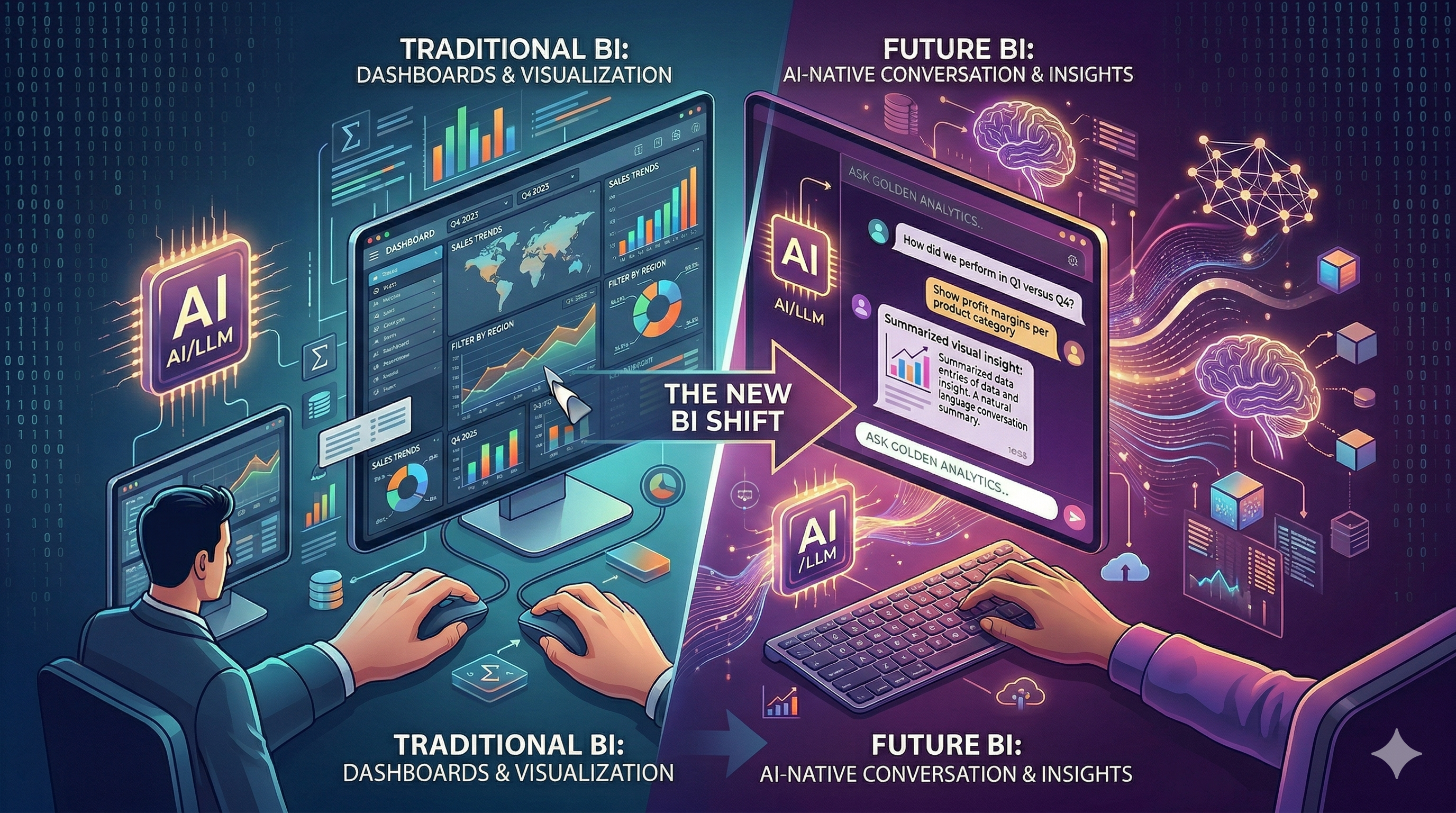
History in the tech world tends to repeat itself. Years ago, the Business Intelligence landscape experienced a massive tectonic shift: the visual analytics revolution. Heavy, rigid, IT-driven reporting tools like Cognos were suddenly dethroned by the intuitive, drag-and-drop interfaces of Tableau.
Today, we are standing at the precipice of the next great shift. Only this time it's about including AI in BI Tools. And just like before, the established giants might have a hard time keeping up.
The Retrofit Struggle
The traditional "Big Boys" of the current era like Microsoft (Power BI) and Salesforce (Tableau) are currently in a race to "bolt on" AI. They are embedding Copilots and Generative AI features into every corner of their existing software. While these updates look impressive in demos, they are fundamentally constrained by the architecture they were built upon: a world designed for manual modeling and pre-defined dashboards.
Trying to force true AI capabilities into a already existing tool is like putting a jet engine on a horse-drawn carriage. It moves faster, but it wasn’t built for the sky. The younger electric car companies are also better equipped to create the car of the future than the traditional car companies.
The AI-Native Wave and the New Kids on the Block
The real disruption comes from newcomers who have built from the ground up. These "AI-native" tools don't start with a blank dashboard; they start with an analysis of the data provided, featuring a Large Language Model (LLM) at their absolute core.
A perfect example of such a new player is Golden Analytics, as well-known BI content creator JustTim recently highlighted in this video during a conversation with its founder. These new tools are fundamentally changing how we handle data. They naturally understand the business context (semantics), which paves the way for genuine ad-hoc insights rather than static reports.
The Rise of the Specialists
Because AI fundamentally lowers the barrier to entry for generating insights, new tools are moving away from the "one-size-fits-all" tactic. Instead, we see different tools focusing on distinct parts of the data journey. For instance, while relatively new and highly capable tools like Sigma are carving out a massive niche as the go to solution for direct cloud data warehouse interaction and financial data visualization, tools like Golden Analytics or Ridge AI focus on conversational insights backed by AI. The modern data stack is becoming specialized.
The DDBM Perspective
At DDBM, our philosophy is clear: we do not push a specific vendor or general tool simply because it holds the largest market share. We look at your business first. We dive into your unique processes, challenges, and data maturity to advise you on the absolute best tooling for your specific situation.
To achieve this, we stay right on top of all the new developments in the data landscape. This allows us to understand exactly what is needed in your scenario whether that means implementing a specialized tool like Sigma for your finance team, providing training for your current tools (Tableau/Power BI). At DDBM we now also develop tailor made solutions with AI based on the needs of our clients. DDBM ensures that your organization becomes truly data-driven and ready for the future.