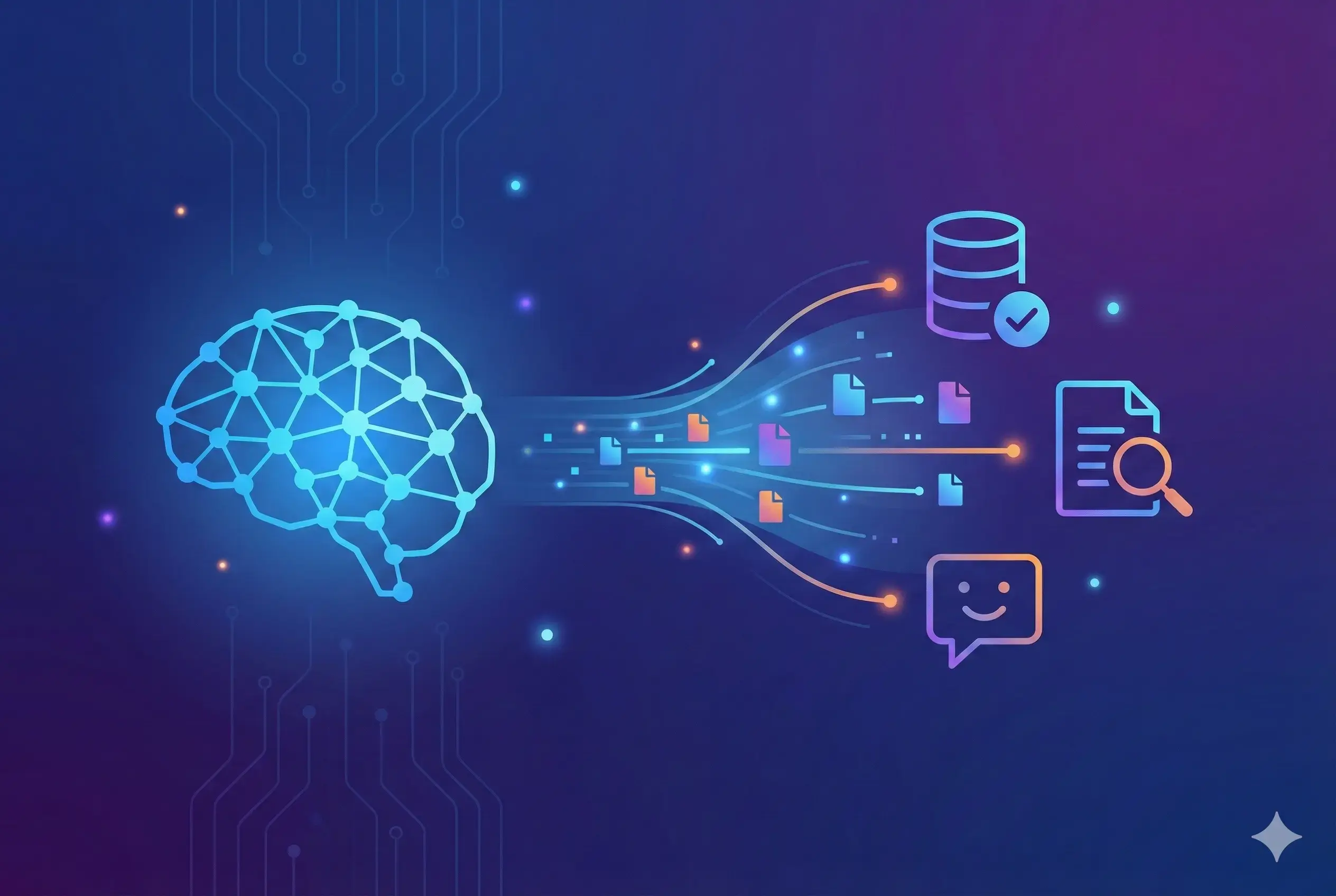
If AI can build in an afternoon what used to take a team weeks to do, does that mean you no longer need to understand how it works? More and more executives are unwittingly acting as if the answer is yes. That’s a misconception. Development speed and understanding are two different things, and AI has primarily accelerated the former. What gets delivered faster still needs to be understood, maintained, and monitored by people who know what they’re doing. AI isn’t a miracle machine that takes care of that on its own. It’s a tool, and it’s only as good as the knowledge of the person operating it.
Knowledge that leaves with the person
Every organization has a version of this story. Somewhere in a spreadsheet is a cell that has been part of a chain of formulas for years. No one knows exactly why anymore, but as soon as someone deletes it, the results no longer add up. The person who understood why is long gone.
AI systems face the same problem, only faster and on a larger scale. Consider a forecasting model that has been making accurate predictions for two years, built by someone who has since left, with no one left who knows which exceptions were factored in—for example, to account for seasonal peaks. If the developer leaves, you can train a replacement relatively quickly, provided the organization has already documented that knowledge. Without that documentation, however, the onboarding process takes much longer than expected, and the replacement is left guessing at the original reasoning.
That’s no reason to distrust AI. It is, however, a reason not to let knowledge remain solely in someone’s head, but to document it and establish governance, so that the organization itself continues to understand why its systems do what they do, even as personnel change.
A good answer isn’t always the right answer
At their core, language models are built to predict the next most likely word, supplemented by instruction-based training and the ability to consult external tools. This works surprisingly well. But surprisingly well isn’t the same as guaranteed correct. Consider an AI tool that makes a churn prediction that looks plausible but is secretly based on an outdated definition of an active customer. Was the adjustment exactly where you wanted it, or just slightly off?
As long as no one can verify the answer, you can’t answer that question. A black box that only shows a result—without revealing the path to it—is uncomfortable for executive management. Not because the result is necessarily wrong, but because there’s no way to verify it. No insight into the process means no due diligence.
The solution isn’t complicated, but it does require discipline: demand that the outcome be verifiable—and preferably the path to it as well. “Show us the work” may sound like a schoolyard demand, but it is precisely what enables an organization to trust AI without blindly relying on what is presented.
Building something quickly can be a false start
There’s a third pattern we see time and again. An organization quickly has an initial version built—for example, a dashboard, a data model, or a small AI application. It works; the immediate problem is solved; and no one pauses to consider whether this is also a solid foundation for what comes next.
The risk doesn’t lie in the rigidity of the end result. It lies in the fact that a quick initial choice—such as how data is structured or which assumptions are implicitly embedded—becomes the foundation upon which everything else is built. If that foundation is even slightly off, you won’t notice it right away. You only notice it during the next expansion—and the one after that—when each step becomes a little more difficult because you constantly have to build around it instead of building on it.
You don’t prevent this by building more slowly, but by explicitly considering, during the initial design phase, which assumptions you’re establishing—and whether someone in the organization can evaluate them before they become the new standard.
The bottom line
AI has made development cheaper and faster, but the cost of maintenance and quality hasn’t disappeared. It’s just been pushed to a later stage. It hasn’t solved the issues of who retains the knowledge when people leave, how to verify an outcome before trusting it, or whether a quick initial version is a solid foundation or, on the contrary, a starting point that makes every subsequent step more difficult. These aren’t technical details you can sort out later. These are choices that must be made in advance, and that requires people within your own organization who understand exactly what’s happening under the hood.
Organizations that take these three points seriously find that AI makes them faster without losing control. Organizations that overlook them usually don’t realize it until it’s already causing problems.
Want to know where your organization stands on these three points? We help organizations not only build a solid data platform but also gain better control over their data and the tools they use—from data engineering to analytics—with AI simply serving as one of those tools. Schedule a 30-minute, no-obligation intake session, and we’ll work with you to find the best solution.