From Gut Feeling to Data-Driven Decisions
Intro
Whether we like it or not: we all have to deal with more and more data, both business and personal. This data, if used in the right way, can go a long way toward helping you achieve your goals. It provides the insights you need to make better decisions.
If we set up and automate the data processes in the right way, you can make informed decisions and productivity will increase so that you and your colleagues have more time for other work.
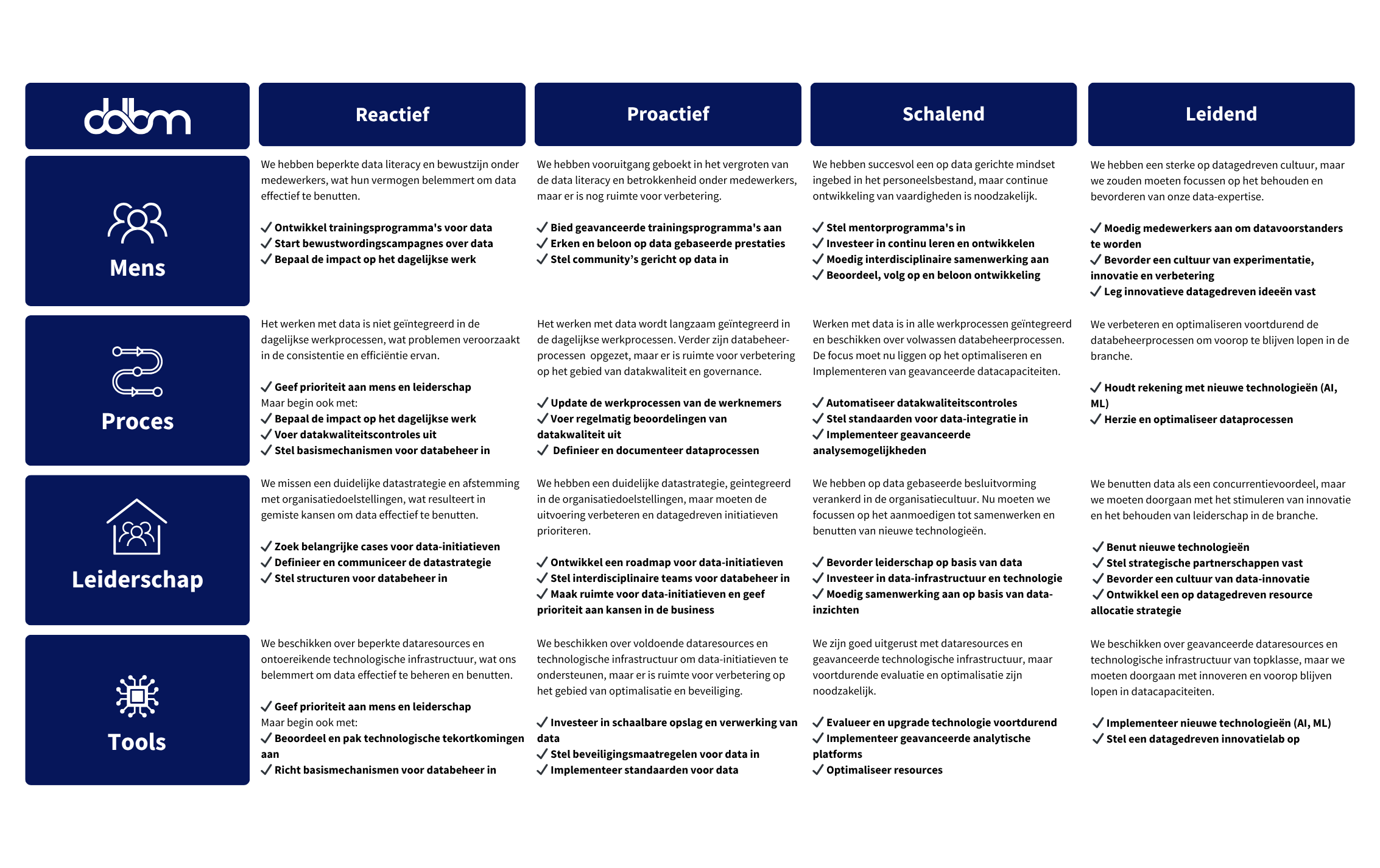
To help you do this, we have developed the Data Impact Model. This model shows you the steps you can take to make better use of data. In doing so, we focus on four key areas: People, Process, Leadership and Tools. If you want to work (more) data-driven, you need to ensure that employees have the right skills and mindset (People), that data is smoothly integrated into the daily routine (Process), that working with data is encouraged and aligned with the strategic objectives of the organization (Leadership), and that the right tools, technologies and data are available (Tools).
In this white paper, you will learn what steps you can take to achieve the level of excellence in each domain that will enable you to get more value from data for your organization.
What is the value of data?
The value of data is often difficult to calculate exactly. This is because most data has no intrinsic value, but the value arises when you do something with that data. At the same time, we know that the most valuable companies in the world are data companies. They collect as much data as possible, determine the areas of interest of their customers, make predictions and thereby accelerate innovation or improve their service. The interesting thing is that you can reuse data infinitely and the value of data increases once you make it available to others - inside or outside the organization.
About this paper
We wrote this white paper to support marketers, analysts, managers, CEOs, finance and HR professionals from medium to large organizations to leverage their data and become more data-driven. Because they work every day to achieve the best results for their organizations, and we are convinced that data can help them do that. We see in practice that the potential is there, but that many organizations struggle with how to embrace data. That's why we provide tips and tricks, a pragmatic model for setting it up, and several real-life examples that will get you started quickly.
Data Impact Model
We measure the success of data initiatives by the impact they have for our clients. Based on our expertise and years of experience, we have developed the Data Impact Model: a structure that helps organizations shape a strategic framework for their data initiatives.
To make the framework as clear and practical as possible, we start from four domains, which we explain below. Within each domain, you have four different levels of maturity.
In our Data Impact Model, we indicate for each domain and level what is involved, and what actions you need to take to stay at the level or to be able to grow to the next level.
People
People generally make the decisions. In everyday life, this is often done based on gut feeling. In recent years, however, we see more and more decisions being made based on data, both in organizations and by individuals. Consider, for example, improving your sports performance using apps such as Strava and Runkeeper. Technological developments are currently moving very fast and many people are struggling to keep up.
By changing our mindset and better understanding why data can help us, we are going to teach ourselves to back up our decisions with data. Organizations that recognize this are therefore investing, for example, in sharing user experiences, providing training and hosting inspiration sessions. Ultimately, you want everyone in your organization to know and understand how data can be better utilized so that you will achieve better results. Those results could be higher profitability, better patient care, better sports performance, lower environmental impact, etc.
Those individuals who can explore, understand and interact with data can be labeled data literate. They can decide what data to use and interpret to make the right decisions. Those who can do this report that they are happier with their work. The result is that you will have enthusiastic employees who are likely to work with you longer, improve organizational results, reduce costs and innovation will increase.
So it is important to improve your data skills. As a foundation, you need to be able to perform simple data analysis and formulate conclusions. Then you will work toward more advanced techniques such as data science, machine learning and AI. Always consider self determination theory.
Within the domain 'People' we distinguish four phases in which your organization can find itself. For each phase you can see the most important characteristics and the concrete steps you can take to grow to the next level.
Reactive
What happens at this stage?
- Decisions made on gut feeling
- Simple ad hoc reports in Excel
- Training in standard office software
What can you do to develop?
- Develop data training program
- Start internal awareness campaign
Proactive
What happens in this phase?
-
Value of data is seen more
-
Limited number of data analysts
-
Multiple data sources are combined (manually in Excel)
-
First dashboards appear
-
Number of people receive training in developing data skills
What can you do to develop?
-
Set up first internal data community
-
Roll out advanced training programs
-
Reward data-driven work
Scaling
What happens in this phase?
-
Strongly increasing data skills
-
Data-driven work is the standard
-
Predictive analytics are being created and used
-
Cross-functional collaboration on data initiatives
-
More people receive training in developing data skills
What can you do to develop?
- Invest in continuous learning and development
- Encourage innovation
- Establish mentoring programs
Leading
What happens in this phase?
-
Everyone is fully data driven
-
Everyone in the organization receives data skill training
-
Data skills are a core competency
-
Continuous focus on innovative experiments
-
Focus on emerging data technologies (such as AI, Machine Learning) and industry trends
-
Encourage and reward innovative data-driven initiatives
-
Keep data skills at a high level
-
Create a culture of open dialogue and collective decision-making
Process
If you want to become a data-driven organization, you will also need to put processes in place. Think about processes for where you get data from and where and how you process it so that the user can be assured that the data is up-to-date, complete, consistent and reliable.
With these processes, you can ensure that data is readily available to anyone who needs it. You won't escape rules and guidelines (governance), establishing who can see what, and especially what not (security). This will vary enormously per type of organization, and you must always take privacy legislation into account.
The important thing is that both the processes surrounding data are set up properly and that the work processes of employees are set up in such a way that they can work with data on a daily basis. So it is about preparing the data for the organization in such a way that it can then easily be used.
Ultimately, we want to use these processes to create an environment that will increasingly support self-service. Self service has the advantage that users themselves can immediately start using data where necessary. However, the more self-service you offer, the more tightly you must organize your processes. Think especially about data and content governance.
Data governance is not about limiting the access of a few users, but about giving broad groups of users proper control over data.
The goal of content governance is to set up processes related to authorization and promotion, for example. Here you have to answer questions such as: who is allowed to access which dashboards, how can you put a dashboard live in production, how do we validate the content in a dashboard and what about the corporate identity? This ensures that there is not a wild west of dashboards, causing people to lose the overview, the reliability decreases and we produce even more reports in, for example, Excel.
Within the domain 'Process' we distinguish four phases in which your organization can find itself. For each phase you see the most important characteristics and the concrete steps you can take to grow to the next level.
Reactive
What happens in this phase?
- Working with data is not integrated into daily work processes
- This causes problems in its consistency and efficiency
What can you do to develop?
- Give priority to people and organization
But also start with:
- Determine the impact on daily work
- Perform data quality checks
- Establish basic data management mechanisms
Proactive
What happens in this phase?
- Working with data is slowly being integrated into daily work processes.
- Data management processes are in place.
- There is room for improvement in data quality and governance.
What can you do to develop?
- Update employee work processes.
- Conduct regular data quality reviews.
- Define and document data processes.
Scaling
What happens in this phase?
- Standards are used and accepted.
- Governance is in place.
- Quality of data can be better ensured through monitoring.
What can you do to evolve?
- Automate data quality controls.
- Automate governance.
- Adapt processes to support more advanced analytics techniques.
Leading
What happens in this phase?
- Working with data is fully implemented in daily operations and processes.
- Data-related processes are reliable and automated as much as possible.
- Standards have been implemented where possible and are strictly adhered to.
- There is full understanding of where data plays a role within the organization.
What can you do to develop?
- Leverage emerging technologies.
- Review and optimize processes and standards continuously.
Leadership
Your organization most likely has clear business goals. But to what extent have you included a data strategy in them? We see in (large) data-driven organizations that there is a clear focus to achieve certain data goals. It is important that directors and management see the importance of this, because we are collecting more and more data anyway. If you use this as usefully as possible then you can start to better understand and support your customers, patients, stakeholders, etc., produce better products or even monitor data.
Leadership plays a crucial role in guiding and supporting the data-driven culture within the organization. Sufficient space must be created to innovate and experiment with data. There must also be room to make mistakes and not to be punished immediately for them. This is called a growth mindset and an antifragile environment. A data-driven culture is essential to ensure that data continues to be used in the long term. The role of leadership is to encourage working with data by inspiring, engaging and motivating people.
Leadership further considers how the data-driven organization will be set up. Will you work with centralized or decentralized data analysis teams, or just a combination of these (e.g., T-shaped). Perhaps you want to work with centralized reports but want everyone to have the ability to access all relevant data where needed (data democracy).
Within the domain 'Leadership' we distinguish four phases in which your organization can find itself. For each phase you see the most important characteristics and the concrete steps you can take to grow to the next level.
Reactive
What happens at this stage?
- Use and usefulness of data is unclear.
- No connection to strategic goals.
- Little support from leadership.
What can you do to develop?
- Find valuable data use cases.
- Develop a data strategy.
- Think about data management.
Proactive
What happens in this phase?
- Data strategy is in place and communicated.
- There is a need to improve implementation of data initiatives.
- There is a need for clarity on what data is used for.
What can you do to develop?
- Develop a roadmap for data initiatives.
- Prioritize new, valuable data initiatives.
Scaling
What happens in this phase?
- Data is used in decision making.
- Working with data begins to become part of the culture.
- More and more people want to work with data; scaling up is a necessity.
What can you do to develop?
- Encourage data-driven leadership.
- Invest in data infrastructure.
- Encourage data collaboration and knowledge sharing.
Leading
What happens in this phase?
- Leadership supports and encourages innovation using data.
- Working with data is the norm and is ingrained in the culture.
- Leadership can focus more on future data initiatives.
What can you do to evolve?
- Leverage emerging technologies.
- Establish strategic partnerships.
- Foster a culture of data innovation.
- Develop a data-based resource allocation strategy.
Tools
As a data-driven organization, you need the right Tools in addition to the Human, Process and Leadership domains. Think of the technological infrastructure, but of course also the data itself. How do you ensure that the data enters your systems in the right way (data ingest), where do you store it (data storage), how can you process the data in such a way that it is suitable for analysis (data transformation) and how can you present the data in such a way that you gain direct insights (data visualization)?
Data is like the fuel of this whole process. Where do you get it from and how do you ensure that everyone on your team has easy access to the most current and relevant information? It's not just a matter of access, but more importantly of trust in the data. You need to be able to rely on one central source of truth (single point of truth). Tooling such as data lineage helps to increase this trust.
Since technological developments are moving fast, it is difficult to make the right choices. Our advice: dare to change when that makes progress. Deploy tooling that will help you look further into the future (forecasting). Leverage emerging technologies such as AI and Machine Learning to stay ahead of the competition.
The possibilities are endless. The trick is in going to do it!
Within the domain 'Tools' we distinguish four phases in which your organization can find itself. For each phase you can see the most important characteristics and the concrete steps you can take to grow to the next level.
Reactive
What happens at this stage?
- Data is hard to leverage.
- The ability to manage data well lags.
What can you do to develop?
- Assess and address technology deficiencies.
- Implement basic data management principles.
Proactive
What happens in this phase?
- Technology can support data initiatives.
- Data and technologies are more manageable, increasing quality and usability.
What can you do to evolve?
- Invest in scalable technology infrastructure.
- Improve security.
- Devise standards for tools.
Scaling
What happens in this phase?
- The data infrastructure fits the need well.
- The use of analytical tools is increasing and more widely adopted within the organization.
What can you do to develop?
- Improve the infrastructure.
- Implement more advanced analytics platforms.
- Optimize existing tools.
Leading
What happens in this phase?
- Infrastructure is robust and future-proof.
- Tools are reliable and current.
What can you do to evolve?
- Leverage emerging technologies such as AI and Machine Learning.
- Establish an innovation team to experiment with new tools.
More value from data: where do you start?
Where are you currently with your organization or team? How do you get from the current level at which your organization operates to a higher level? What approach should you take and where do you start? And how do you apply the Data Impact Model in doing so?
Data Impact Scan
If you want to grow to a higher level, you will first need to determine where you are now. With our Data Impact Scan we can measure the maturity of your organization on the different aspects of the Data Impact Model. By comparing the results with the ambition level of your organization, you will gain insight into the steps needed to grow. When you do this with us you will receive a clear plan so you know exactly where you stand, what your organization will have to do itself, where we can help you and how we transfer knowledge.
Data strategy as a basis
One of the most important questions we will discuss: do the data initiatives fit your organization's strategy? One of the questions we're going to ask is:
- Does it clearly add value to the organization, and if so, where and how?
- Who can access what data and how easy is it?
- How does the leadership team view data-driven work?
- Can we work more efficiently, make better decisions or minimize cost waste?
- Can we use this to serve our customers better or smarter?
- Does it increase our competitiveness?
- Does it yield more in the short or medium term than it costs?
Want to talk further?
Would you like to know more about the practical deployment of the Data Impact Model? Our experts are happy to help you think about a strategy that really adds value. Send us a message for an informal meeting.